

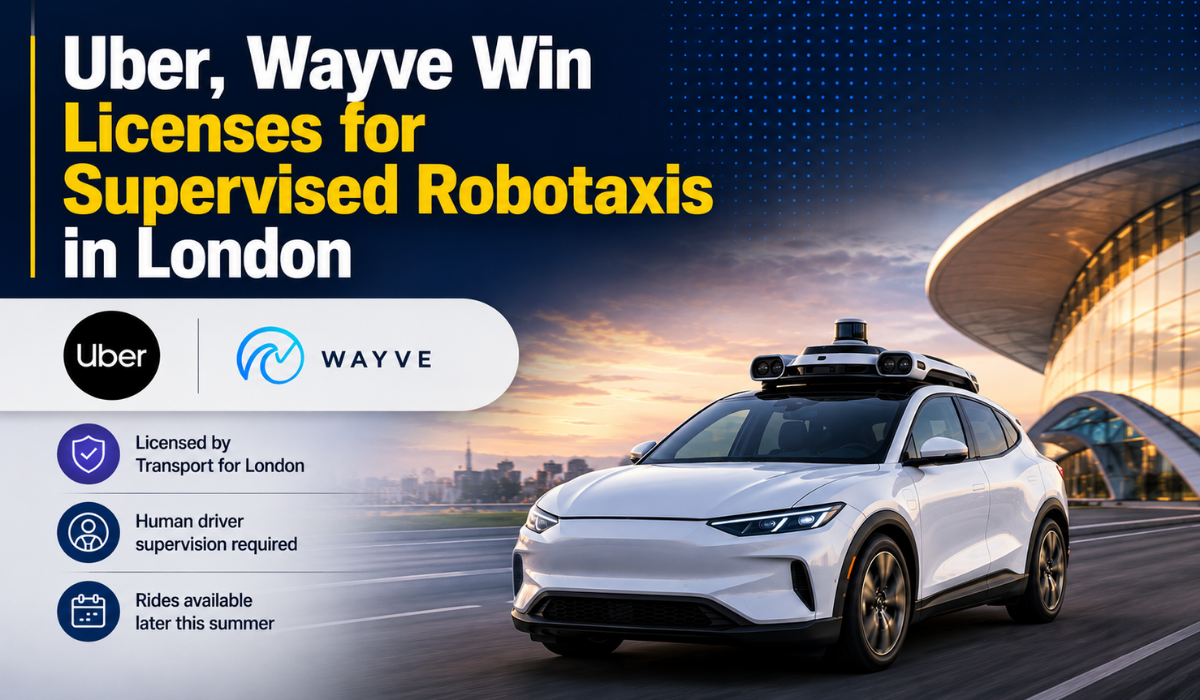
The London robotaxi initiative has reached a significant breakthrough following Transport for London (TfL)’s decision to issue private hire vehicle (PHV) licences to a fleet of autonomous cars operated by Uber and powered by UK-based AI company Wayve. This approval, first reported by BBC News , enables the vehicles to begin carrying passengers under tightly controlled conditions, marking a major step toward autonomous ride-hailing in the capital.
Despite the advanced self-driving capabilities installed in the vehicles, each trip must initially include a trained human safety driver. This driver remains fully legally accountable for the vehicle and all passengers, even when autonomous systems are active.
Uber stated that TfL conducted detailed inspections and confirmed the vehicles comply with all required safety and operational standards. A limited group of passengers is expected to experience the London robotaxi service later this summer, ahead of a broader rollout.
A Major Regulatory Step for TfL
The approval represents an important milestone for the London robotaxi programme and its regulatory progress.
In London, private hire operations require three separate licences issued by TfL: one for the operator, one for the driver, and one for the vehicle itself. With all three now in place, Uber can begin supervised autonomous passenger journeys under the city’s regulatory framework.
However, this approval does not allow fully driverless commercial operations. Any future removal of the safety driver will require additional authorisation from the Driver and Vehicle Standards Agency (DVSA).
TfL reiterated that road safety remains its top priority and that all licensed services must align with the city’s Vision Zero strategy, which aims to eliminate fatalities and serious injuries on London’s roads by 2041.
Technology Designed with Safety in Mind
The London robotaxi fleet is made up of modified electric Ford Mustang Mach-E vehicles equipped with Wayve’s advanced autonomous driving system.
Each vehicle includes a range of sensors and computing systems, such as:
- Roof-mounted camera units
- Side mirror-integrated cameras
- Radar detection systems
- Onboard AI processing hardware
Together, these components allow the system to interpret real-time road conditions, detect pedestrians, cyclists, vehicles, traffic signals, and lane markings, and assist the human driver throughout the journey.
London Robotaxi Fleet Summary
| Feature | Details |
| Operator | Uber |
| AI Technology Provider | Wayve |
| Vehicle Model | Ford Mustang Mach-E (Electric) |
| Safety Driver Required | Yes |
| Regulator | Transport for London (TfL) |
| Passenger Service Start | Expected later this summer |
Strong Public Interest in the Service
Uber revealed that interest in the London robotaxi programme has grown rapidly, with over 100,000 people already registering their interest in trying the service.
A portion of these users will be invited to take part in early supervised rides later this summer, before the service gradually expands to a wider audience.
This level of demand highlights increasing public curiosity about autonomous transport, particularly when combined with human oversight during early deployment stages.
Safety and Oversight Remain Central
TfL has emphasised that the introduction of autonomous vehicles will not compromise existing safety standards.
Although Wayve’s system is capable of handling many driving tasks, the licensed human driver remains responsible for every journey and must be ready to intervene at any moment.
This hybrid approach allows regulators to carefully assess autonomous technology in real-world conditions while maintaining full legal accountability and passenger protection.
Industry Response and Future Implications
Wayve described the approval as a key achievement for autonomous mobility in the UK, highlighting its potential to support safer, more efficient, and environmentally friendly urban transport.
The company also noted that it will continue working closely with regulators, local authorities, and communities to ensure responsible deployment of its technology.
Uber welcomed the decision as an important step toward integrating British-developed autonomous systems into commercial ride-hailing services.
Meanwhile, the announcement has sparked discussion within the taxi and private hire industry. While human drivers are still required, some industry groups have raised concerns about the long-term impact of automation on employment. The Licensed Taxi Drivers’ Association has been contacted for comment.
London Becomes a Key Market for Wayve
Founded in 2017 by two Cambridge University researchers, Wayve has grown into one of the UK’s leading autonomous driving technology firms.
The company is also collaborating with global manufacturers such as Nissan and Stellantis to integrate its AI driving system into consumer vehicles.
With this rollout, London will become the first city globally to deploy Wayve’s technology in commercial passenger services, marking a major milestone for both the company and the UK’s autonomous vehicle sector.
Key Highlights
- TfL has issued private hire licences enabling the London robotaxi programme to begin supervised operations.
- A human safety driver will remain in every vehicle during the initial phase.
- Uber will operate electric Ford Mustang Mach-E vehicles powered by Wayve’s AI system.
- More than 100,000 users have shown interest, with early rides expected later this summer.
- Fully driverless services will require further approval from the DVSA.
- London will be the first city to commercially deploy Wayve’s autonomous technology.
Frequently Asked Questions
What is the London robotaxi service?
The London robotaxi service is an autonomous ride-hailing initiative operated by Uber using Wayve’s self-driving technology under TfL regulation.
Are these vehicles fully driverless?
No. A trained human driver must be present in every vehicle and remains legally responsible for all journeys.
What cars are being used?
The fleet consists of electric Ford Mustang Mach-E vehicles fitted with cameras, radar systems, and Wayve’s AI-based driving software.
When will passengers be able to use the service?
Early invited passengers are expected to begin supervised rides later this summer, followed by a wider rollout.
Conclusion
The approval of the London robotaxi programme marks a major step forward for autonomous transport in the UK. While a human driver will remain in control during the initial phase, Uber and Wayve are now able to begin real-world passenger testing under TfL supervision. As the technology continues to develop and regulatory assessments progress, the London robotaxi initiative could play a defining role in shaping the future of urban mobility while maintaining strict safety standards.