

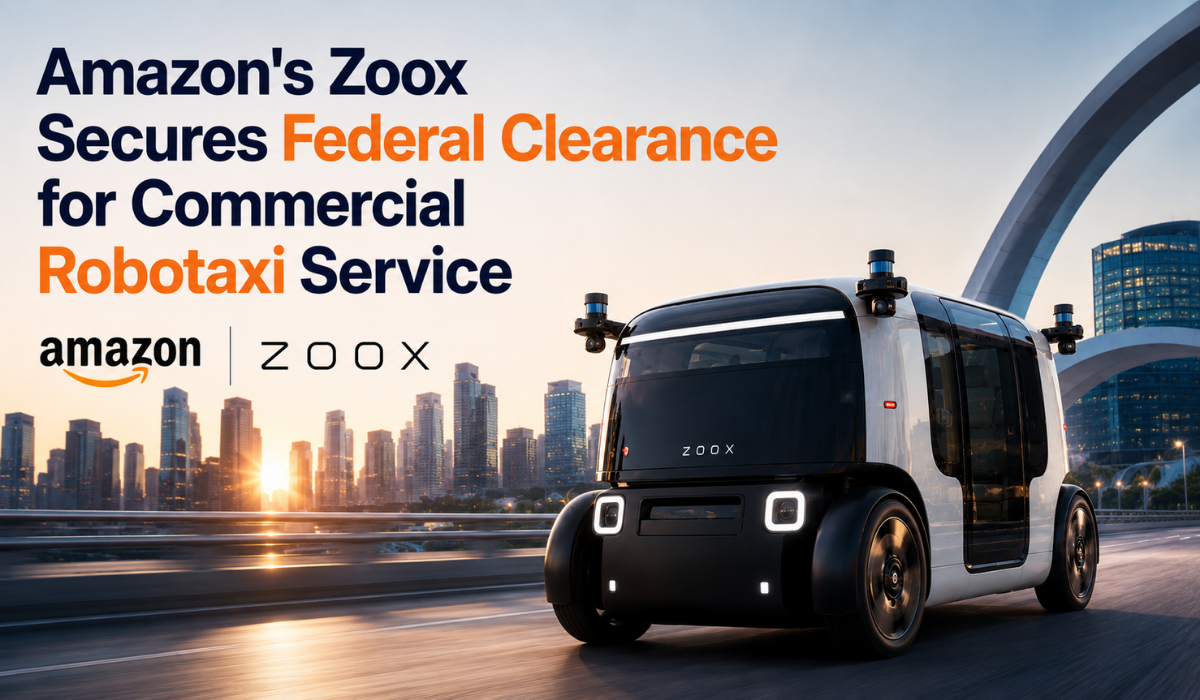
The autonomous vehicle industry has reached another significant milestone as the Zoox robotaxi moves closer to commercial service. A recent federal regulatory decision has cleared an important path for the Amazon-owned autonomous vehicle company to begin offering paid rides using its purpose-built self-driving vehicles.
The approval is more than a company achievement—it reflects the broader progress of autonomous mobility in the United States. It also demonstrates how regulators are adapting existing vehicle rules to accommodate new transportation technologies that do not fit traditional automotive designs.
Although additional state-level approvals remain necessary in some markets, the latest federal decision strengthens the foundation for commercial autonomous ride-hailing while providing valuable guidance for the wider self-driving vehicle industry.
Key Takeaways
| Highlights |
| Zoox has secured a key federal exemption supporting commercial robotaxi operations. |
| The approval allows the company to begin charging passengers where all required approvals are in place. |
| The exemption applies to purpose-built autonomous vehicles without steering wheels or pedals. |
| Commercial deployment will initially be limited under federal oversight. |
| Las Vegas is expected to be the first commercial launch market. |
| Regulators are also advancing broader autonomous vehicle safety initiatives across the U.S. |
Why This Approval Is Important
For autonomous vehicle companies, technological progress alone is not enough to launch commercial services. Regulatory approval plays an equally important role in determining when autonomous transportation can move from testing to everyday passenger use.
The latest federal decision enables the Zoox robotaxi program to transition toward paid operations using vehicles designed exclusively for autonomous driving. Unlike conventional passenger vehicles, Zoox robotaxis are built without steering wheels, brake pedals or accelerator pedals.
The exemption is widely viewed as an important regulatory milestone because it recognizes that purpose-built autonomous vehicles may require a different regulatory approach than traditional cars while still meeting safety expectations.
A Different Type of Autonomous Vehicle
Many autonomous vehicle developers adapt existing production vehicles by installing sensors, cameras and self-driving software.
Zoox has taken a different approach by designing its robotaxi from the ground up specifically for autonomous transportation. The vehicle is built to operate without traditional driver controls, allowing passengers to travel without a human driver actively controlling the vehicle.
Because of this unique design, federal regulators granted exemptions from selected vehicle safety standards that were originally written for conventional driver-operated vehicles.
This demonstrates how regulation is gradually evolving alongside advances in autonomous vehicle technology.
Commercial Rollout Will Be Gradual
The federal approval allows Zoox to begin charging passengers where commercial operations meet applicable regulatory requirements.
The company has indicated that Las Vegas will be its first commercial market before expanding into additional locations over time.
However, commercial deployment will not happen everywhere immediately. In California, where Zoox continues testing autonomous vehicles and offering free rides in certain programmes, additional approvals from state regulators are still required before paid passenger services can begin.
This phased rollout allows both regulators and operators to evaluate performance while expanding services responsibly.
Federal Oversight Remains in Place
The approval does not remove regulatory oversight.
Under the exemption, the Zoox robotaxi fleet will initially be limited to up to 2,500 vehicles annually for two years. During this period, federal regulators will continue monitoring deployment through an oversight framework designed to adapt as the technology develops.
This balanced approach encourages innovation while ensuring autonomous vehicle companies remain accountable as commercial services expand.
Regulatory Overview
| Area | Significance |
| Federal exemption | Enables commercial autonomous ride-hailing under defined conditions |
| Purpose-built vehicle design | Supports vehicles without traditional driving controls |
| Fleet limitation | Up to 2,500 vehicles annually for two years |
| Initial commercial market | Planned rollout begins in Las Vegas |
| State approvals | Additional permissions required before expansion into some regions |
| Ongoing oversight | Federal monitoring continues throughout deployment |
A Broader Shift in U.S. Autonomous Vehicle Policy
The Zoox announcement was part of a wider series of autonomous vehicle policy developments.
Federal regulators also announced updates to the exemption process for innovative vehicle designs, making it easier for manufacturers to introduce limited numbers of non-traditional vehicles for technology evaluation under regulatory supervision.
In addition, government agencies are supporting industry efforts to develop more consistent autonomous vehicle safety standards through collaborative research initiatives.
These broader actions demonstrate that regulators are working not only to evaluate individual companies but also to establish a stronger long-term framework for autonomous transportation across the United States.
Opportunities and Remaining Challenges
Commercial autonomous ride-hailing offers several potential benefits, including improved transportation accessibility, greater operational efficiency and new mobility options for passengers.
At the same time, important challenges remain.
Public confidence, cybersecurity, insurance requirements, infrastructure readiness and continued regulatory coordination will all influence how quickly autonomous transportation expands.
Developers must also demonstrate that autonomous systems perform safely across diverse road conditions, traffic environments and weather situations before large-scale deployment becomes commonplace.
What This Means for the Future
The progress of the Zoox robotaxi illustrates how autonomous mobility is steadily moving beyond research and pilot projects.
Rather than focusing only on technological innovation, the industry is placing increasing emphasis on regulatory compliance, safety validation and responsible commercial deployment.
The latest approval also provides an important reference point for other autonomous vehicle developers seeking to introduce purpose-built self-driving vehicles in the future.
As regulations continue evolving alongside technology, cooperation between manufacturers, mobility providers and government agencies will remain essential for the successful expansion of autonomous transportation.
Final Thoughts
The federal approval supporting the Zoox robotaxi represents an important milestone for both the company and the wider autonomous vehicle industry.
By allowing commercial operations under defined regulatory conditions, the decision demonstrates growing confidence in purpose-built autonomous vehicles while maintaining strong oversight during early deployment.
With Las Vegas expected to become the first commercial market and additional regulatory approvals progressing elsewhere, Zoox is moving closer to introducing autonomous ride-hailing to paying customers.
At the same time, broader federal initiatives aimed at improving autonomous vehicle regulations and developing national safety standards suggest that the United States is continuing to build the framework needed for the long-term growth of autonomous mobility.
Frequently Asked Questions
What is the Zoox robotaxi?
The Zoox robotaxi is a purpose-built autonomous vehicle designed to provide paid ride-hailing services without traditional controls such as a steering wheel or pedals.
Where will Zoox launch its first commercial robotaxi service?
Las Vegas is expected to be the first market for Zoox’s commercial robotaxi service, while expansion into other locations will depend on additional regulatory approvals.
Why is the federal exemption significant?
The exemption allows purpose-built autonomous vehicles to operate commercially under specific conditions, representing a major regulatory milestone for the autonomous vehicle industry.
Can Zoox immediately expand across the United States?
No. Although the federal approval is an important step, additional state and local regulatory approvals are required before commercial services can launch in some regions.
What does this approval mean for the autonomous vehicle industry?
The decision demonstrates continued progress toward commercial autonomous transportation while highlighting the importance of balancing innovation, public safety and regulatory oversight.