

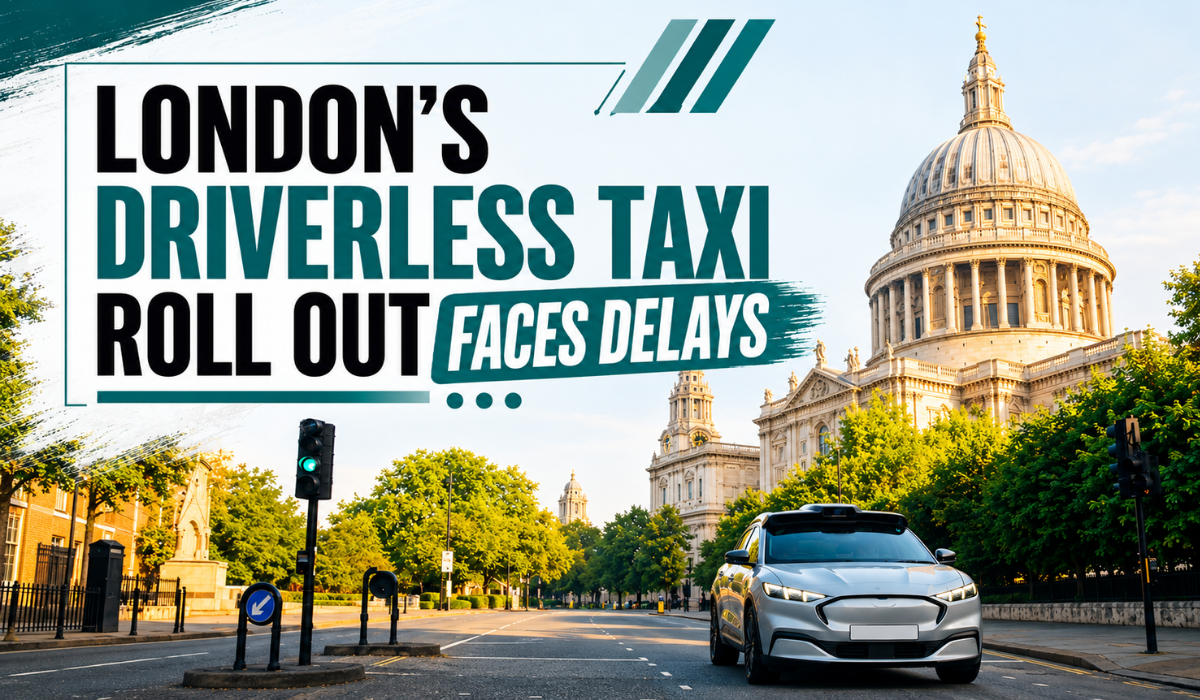
Londoners may have to wait longer than expected before fully autonomous taxis without a human driver become available. Plans for driverless taxis in London are facing delays as important regulatory requirements and operational guidance remain unfinished.
Uber, Waymo and other autonomous vehicle companies have been preparing for self-driving passenger services in the UK capital. However, operating a commercial service without a human driver requires operators to complete several regulatory steps before passengers can travel in fully driverless vehicles.
Although the UK government and industry had previously hoped that commercial autonomous services could begin as early as 2026, the remaining approval process means the timeline for fully driverless passenger services is now uncertain.
Regulatory Process Remains Incomplete
Under the government’s pilot framework, a passenger-carrying service operating without a human driver requires an Automated Passenger Services (APS) permit.
The permit process is handled through the government’s Driver and Vehicle Standards Agency (DVSA), while Transport for London (TfL) provides consent for operations in London at the appropriate stage of the process.
According to TfL, no operator has yet completed the first stage of the approval process by registering vehicles with the Vehicle Certification Agency. TfL also said it had not received applications for a DVSA permit or consent to operate a fully driverless passenger service in London.
This means the process required to introduce driverless taxis in London has not yet reached the final approval stage.
TfL Guidance Is Still Pending
Another major issue is the lack of final operational guidance from TfL for companies seeking approval to operate autonomous passenger services.
Christina Calderato, TfL’s Director of Strategy, previously told the London Assembly’s Transport Committee that the organisation was not rushing to publish its driverless vehicle guidance because significant work was taking place behind the scenes.
TfL has since said that its guidance will be issued shortly, but it has not confirmed a specific publication date.
The absence of final guidance makes it difficult to predict exactly when operators will be able to complete every stage of the approval process.
From Spring 2026 Plans to an Uncertain Timeline
The delay comes after Transport Secretary Heidi Alexander accelerated the government’s timetable for autonomous vehicle trials in 2025. The revised plans created expectations that commercial self-driving services could begin as early as spring 2026.
However, the necessary approvals and local operating requirements have taken longer to develop.
The Department for Transport has said that the wider framework for the full introduction of self-driving vehicles is still being developed, with broader implementation expected from 2027.
This does not necessarily rule out individual pilot programmes before then, but fully driverless commercial passenger services must still complete the required regulatory process.
Uber and Wayve Can Operate Supervised Rides
While fully driverless services remain subject to additional approval, Uber and autonomous driving company Wayve have already received permission for supervised self-driving taxi rides in London.
The service involves autonomous vehicles operating with a trained and licensed human safety driver behind the wheel who can take control when necessary.
This is an important distinction. A supervised autonomous ride is not the same as a fully driverless taxi service.
The Uber-Wayve programme is expected to provide real-world experience with autonomous passenger rides in London while the regulatory pathway for services without a human driver continues to develop.
| Requirement or Development | Current Position |
| Fully driverless passenger service | Requires further regulatory approval |
| Vehicle registration stage | TfL says operators have not completed this stage |
| APS permit | Required for services without a human driver |
| DVSA applications | No applications received, according to TfL |
| TfL operational guidance | Expected but no confirmed publication date |
| Uber and Wayve service | Approved for supervised autonomous rides |
| Human safety driver | Required for the supervised service |
Waymo Still Has Plans for London
Waymo has also continued preparing for a London launch and has indicated that its plans remain subject to government approval.
The company has maintained its ambition to introduce a fully autonomous service, but the final timing will depend on progress through the safety and regulatory approval process, as well as the publication of the guidance required for operations in London.
This is why the situation should not be described as a confirmed cancellation of driverless taxi plans. Instead, the rollout is facing delays and uncertainty while operators and regulators work through the requirements.
Why the Regulatory Process Matters
The development of driverless taxis in London is now moving beyond technological testing and into a more complex regulatory phase.
Operating autonomous vehicles with a human safety driver is different from carrying paying passengers without anyone behind the wheel. Fully driverless services require a framework that addresses vehicle certification, safety responsibilities and passenger operations.
London also has its own transport authority requirements, meaning national approval alone may not be enough for operators seeking to launch within the capital.
For companies preparing robotaxi services, the completion of the regulatory process will therefore be just as important as the performance of their autonomous driving technology.
What Happens Next?
The next major development will be the publication of TfL’s operational guidance for autonomous passenger services.
Once the relevant guidance and regulatory processes are available, operators will need to progress through vehicle registration and certification requirements, followed by the necessary government permit and consent process.
The speed of these steps will determine whether any operator can launch a fully driverless passenger service in London in the near future.
In the meantime, supervised autonomous rides involving Uber and Wayve could allow passengers to experience self-driving technology while a human safety driver remains responsible for the vehicle.
FAQs
When will driverless taxis launch in London?
There is currently no confirmed launch date for fully driverless commercial taxi services. The timeline depends on regulatory approvals, vehicle certification and TfL’s operational guidance.
Why are driverless taxis in London delayed?
The required approval process is still incomplete. TfL has said that operators have not yet completed the initial vehicle registration stage or submitted the necessary applications for fully driverless passenger operations.
What is an APS permit?
An Automated Passenger Services permit is required under the government’s pilot framework for passenger-carrying services operating without a human driver.
Can Uber already operate self-driving taxis in London?
Uber and Wayve have received permission to offer supervised autonomous rides. However, these vehicles must have a trained and licensed human safety driver present.
Is Waymo still planning to operate in London?
Waymo continues to pursue plans for a London service, but the timing of a fully autonomous operation remains dependent on government and regulatory approval.
Will the UK introduce self-driving vehicle rules in 2027?
The Department for Transport has indicated that the broader regulatory framework for the full introduction of self-driving vehicles is being developed for implementation from 2027.
Conclusion
The arrival of driverless taxis in London is taking longer than many expected, primarily because the regulatory pathway for fully autonomous passenger services is still incomplete.
TfL guidance, vehicle registration, government permits and local consent remain important steps before passengers can travel in a commercial taxi without a human driver.
Uber and Wayve’s supervised autonomous rides could provide an interim step toward wider deployment. Meanwhile, Waymo and other companies remain interested in London’s robotaxi market.
For now, the future of fully driverless taxis in London depends less on announcements and more on how quickly operators and regulators can complete the remaining approval process