

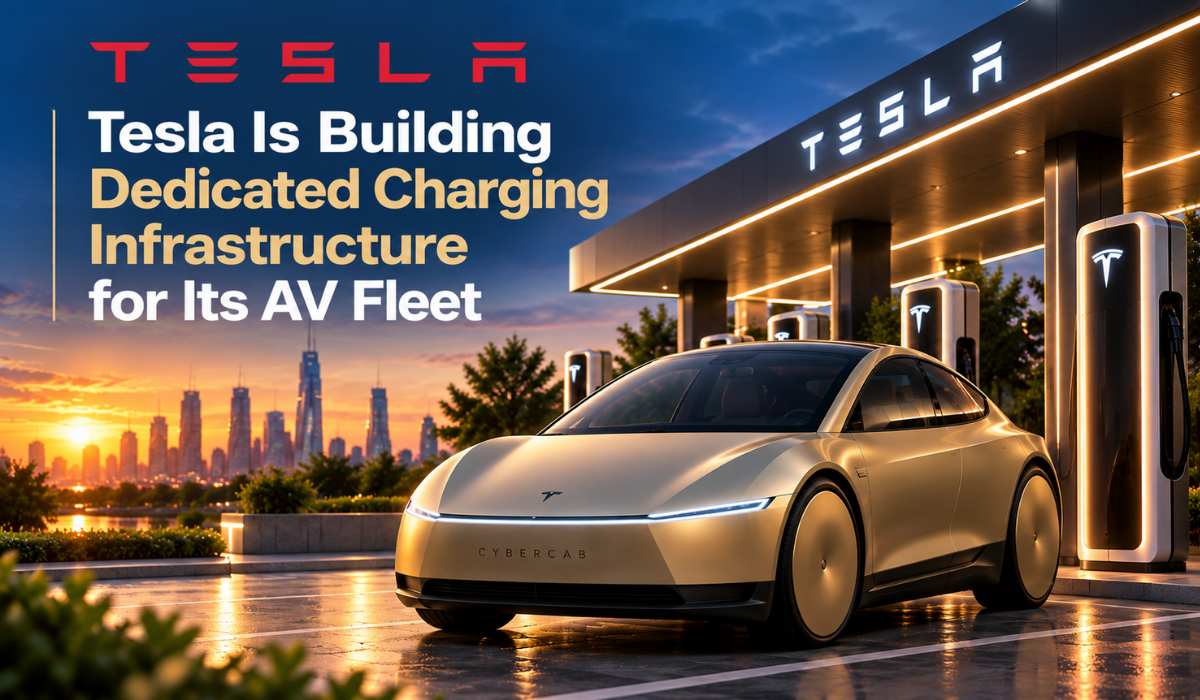
Tesla is developing dedicated Tesla Supercharger sites for its growing robotaxi fleet, highlighting a new infrastructure challenge for autonomous vehicles. The company’s robotaxis currently use public charging locations, where human operators manually connect the vehicles to chargers.
Tesla’s North American charging chief Max de Zegher has indicated that manual charging is only a temporary solution. The company is now working on dedicated charging locations designed around robotaxi demand and fleet utilisation.
Tesla Plans Dedicated Supercharger Sites for Robotaxis
Unlike privately owned electric vehicles, robotaxis could spend much of the day carrying passengers. That means charging infrastructure needs to support frequent vehicle turnover while minimising the time cars spend out of service.
Tesla’s approach is expected to focus on locations where robotaxi demand is high but land costs are relatively low. Dedicated sites could allow vehicles to arrive, recharge and return to passenger service without competing with customers using public Superchargers.
De Zegher has also indicated that passenger-carrying vehicles receive priority at public charging locations, making dedicated fleet infrastructure potentially useful as Tesla scales its robotaxi operation.
The development comes as Tesla’s Cybercab service begins commercial operations in Austin, Texas. Recent reporting has highlighted the wider infrastructure requirements of the robotaxi business, including places to park, charge and maintain autonomous vehicles.
Could the Cybercab Use Wireless Charging?
One of the biggest questions is how a driverless vehicle can recharge without a person handling a charging cable.
Tesla demonstrated wireless charging for the Cybercab in 2024. Reports from that demonstration indicated charging power of roughly 19–21 kW. Tesla has not publicly confirmed a 48-kWh battery capacity, so that specification should not be treated as established fact.
Wireless charging could eventually allow a Cybercab to position itself over a charging pad and recharge without requiring an operator to connect a cable.
Tesla has previously demonstrated robotic charging technology as well, although it has not deployed the robotic charging arm shown in earlier demonstrations at scale.
For a large autonomous fleet, automated charging could become increasingly important because even a small amount of human intervention at every charging session could become difficult to scale.
Why Dedicated Charging Matters
A robotaxi fleet operates differently from privately owned EVs. Vehicles could potentially spend most of the day moving passengers and return to charging facilities repeatedly.
| Challenge | Why it matters for robotaxis |
| Frequent charging | Vehicles may need multiple charging sessions |
| Human intervention | Manual plugging can limit automation |
| High utilisation | Chargers need to support continuous fleet operations |
| Location planning | Sites need to be close to areas with strong demand |
| Fleet management | Charging needs to be coordinated with passenger demand |
This makes charging infrastructure an important part of Tesla’s broader robotaxi strategy, rather than simply an additional feature of the vehicle.
What Europe Could Mean for Tesla’s Charging Strategy
Tesla’s charging network has a particular connection with Europe because the company began opening selected Supercharger locations to non-Tesla vehicles there.
In November 2021, Tesla launched its first pilot for non-Tesla EVs in the Netherlands, initially opening 10 Supercharger locations to other drivers.
Europe has since established common rules for publicly accessible charging infrastructure through the Alternative Fuels Infrastructure Regulation (AFIR).
One important distinction is that AFIR’s charging infrastructure targets are based on publicly accessible charging capacity. The rules therefore distinguish public charging infrastructure from facilities restricted to a limited group of users.
A Tesla facility reserved exclusively for its own robotaxi fleet would therefore raise a different regulatory question from an ordinary public Supercharger site.
Public Charging Also Has Payment Requirements
AFIR also introduced requirements designed to make public charging easier to access without requiring drivers to hold a specific subscription or contract.
For publicly accessible charging points deployed from April 13, 2024, payment requirements depend partly on the charger’s power level. For charging points of 50 kW or more, the rules include requirements for electronic payment options, while lower-powered points can use other compliant electronic payment methods.
These requirements reinforce Europe’s wider objective of making public charging infrastructure interoperable and accessible to a broad range of EV drivers.
Tesla’s Robotaxi Expansion Is Also an Infrastructure Challenge
Tesla’s robotaxi ambitions now involve more than autonomous driving software and purpose-built vehicles. The company also needs infrastructure capable of supporting an expanding fleet.
The recent Cybercab launch in Austin has brought these requirements into sharper focus. Tesla is exploring ways to expand the robotaxi network, while other businesses are also looking at facilities that could provide parking, charging and maintenance for autonomous fleets.
For Tesla, dedicated Supercharger locations could eventually provide greater control over fleet charging and reduce dependence on public charging capacity.
FAQs
Why is Tesla building dedicated Supercharger sites for robotaxis?
Dedicated sites could allow Tesla to charge its robotaxi fleet more efficiently without competing with ordinary customers at public charging locations.
How are Tesla robotaxis currently charged?
Current reporting indicates that operators manually connect robotaxis to chargers at public locations, although Tesla says this is a temporary arrangement.
Could Cybercab use wireless charging?
Tesla demonstrated wireless charging for the Cybercab in 2024. Reports from the demonstration indicated charging power of roughly 19–21 kW, but Tesla has not provided a complete production charging specification.
Would a private robotaxi charging site count as public charging infrastructure in Europe?
Generally, infrastructure restricted to a limited group of users would not be treated the same as publicly accessible charging infrastructure under AFIR.
Does Tesla currently operate Cybercab robotaxis in Europe?
No. Tesla’s current Cybercab commercial operation is in the United States, with the service launched in Austin in September 2026.
Conclusion
Tesla’s dedicated Supercharger plans show how autonomous transportation could change the requirements for EV charging. A robotaxi fleet needs more than vehicles and autonomous-driving software; it also needs reliable infrastructure for charging, parking and maintenance.
Wireless or otherwise automated charging could eventually reduce the need for human intervention, while dedicated Tesla Supercharger sites could help the company manage charging around fleet demand.
As Tesla expands its robotaxi operations, charging infrastructure may become just as important to scaling the service as the vehicles themselves. Europe could present an additional challenge, where the distinction between public charging and fleet-only infrastructure is already embedded in the region’s charging rules.