

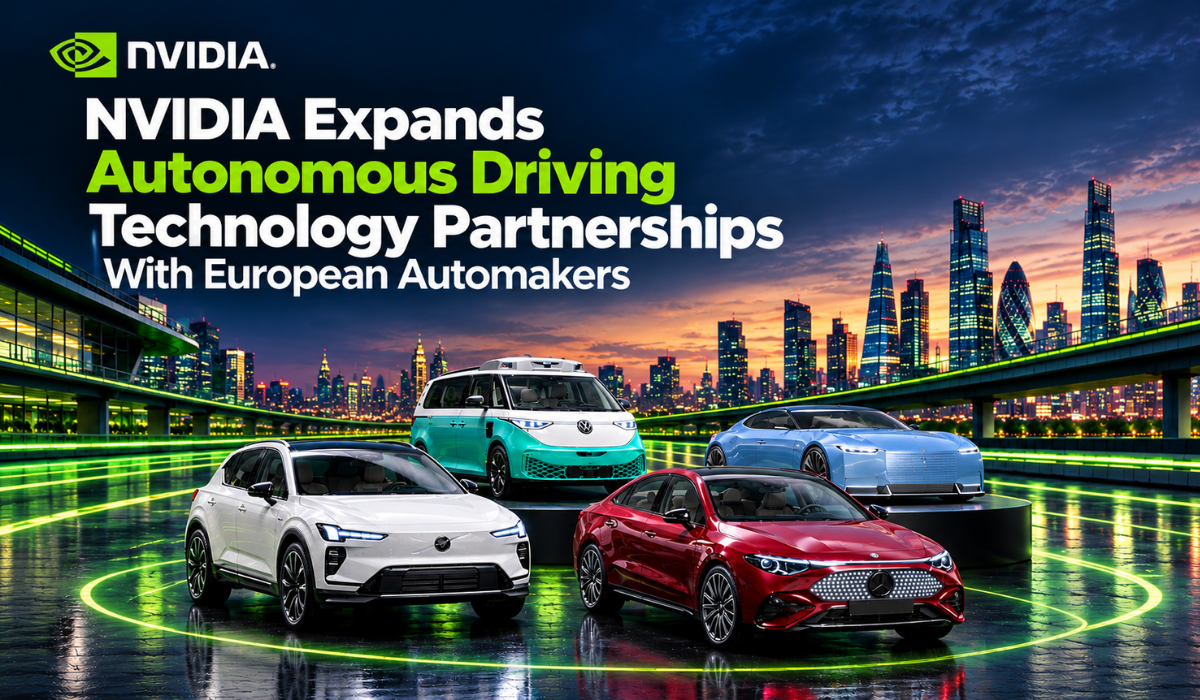
NVIDIA has announced new developments in its NVIDIA Autonomous Driving ecosystem at GTC Berlin, introducing advanced AI models, vehicle computing technology and safety evaluation tools to support the future of self-driving transportation.
Major automotive and mobility companies, including Mercedes-Benz, Volvo Cars, Volkswagen Commercial Vehicles, Bolt and Einride, are working with NVIDIA technologies for automated passenger vehicles, robotaxis and commercial transportation.
The announcement focuses on expanding the NVIDIA Hyperion platform, introducing Halos SAFE and improving AI development tools for autonomous vehicles operating in different environments.
NVIDIA Hyperion Powers Future Autonomous Vehicles
According to NVIDIA’s official announcement, NVIDIA Hyperion is a computing and sensor platform designed to support advanced automated driving systems.
Its modular architecture allows automakers to integrate NVIDIA’s Alpamayo software or use compatible autonomous driving systems developed independently.
The platform supports the development of Level 3 and Level 4 automated vehicles.
Level 3 systems can manage driving under specific conditions but may require a human driver to take control when requested. Level 4 systems can operate without human intervention within their designated operating environments.
NVIDIA aims to provide a common technology foundation for passenger vehicles, robotaxis and autonomous commercial fleets.
Automakers Expand NVIDIA Autonomous Driving Partnerships
Several European automotive and mobility companies are incorporating NVIDIA technology into their development programmes.
| Company | Planned application |
| Bolt and Lucid | European robotaxi development using Hyperion and Alpamayo |
| Mercedes-Benz | Advanced Level 3 and Level 4 driving systems |
| Volkswagen Commercial Vehicles | Autonomous ID. Buzz vehicle platform |
| Volvo Cars | Automated driving using Hyperion, Halos OS and Alpamayo |
| Einride | Autonomous freight transportation |
| TIER IV and Technical University of Munich | Autonomous public transportation research |
These partnerships reflect the growing use of shared computing platforms across different automated transportation projects.
Bolt Plans Robotaxi Development in Europe
Bolt has selected NVIDIA Alpamayo Stack for its European robotaxi programme, initially involving future Lucid vehicles equipped with Hyperion.
The companies plan to adapt the technology to European roads while combining NVIDIA’s driving software with Bolt’s fleet management capabilities.
Subject to regulatory approval, Bolt intends to begin collecting real-world driving data in Madrid in 2027.
Germany is also a priority for future expansion.
The longer-term programme targets at least 25,000 Level 4-capable Lucid vehicles. This remains a planned deployment rather than an existing commercial fleet.
Bolt’s planned robotaxi programme in Madrid reflects the growing development of autonomous transportation across Europe, while regulatory challenges continue to affect the rollout of driverless taxis in London.
NVIDIA Introduces Halos SAFE for Autonomous Vehicle Testing
NVIDIA has introduced Halos SAFE, a framework designed to help developers evaluate autonomous vehicle safety.
Short for Safety Assurance Framework for Evaluation, Halos SAFE connects different testing methods to create measurable evidence of system performance.
The framework brings together virtual simulations, software testing, hardware evaluation, road testing and fleet monitoring.
NVIDIA is collaborating with dSPACE, IVEX and TÜV Rheinland to develop evaluation workflows.
Halos SAFE is intended to support safety assessments, but it does not replace regulatory approval or guarantee safe performance under every driving condition.
New AI Models Strengthen NVIDIA Autonomous Driving Development
NVIDIA also introduced AI models and development tools aimed at improving autonomous driving capabilities.
| Technology | Main purpose |
| Alpamayo 2 Edge | In-vehicle reasoning and motion planning |
| AlpaJudge | Evaluating driving explanations and training data |
| Foundation4D | Labelling multi-camera driving videos |
| Cosmos 3 Nano | Generating synthetic driving data and simulations |
| Cosmos Data Factory | Preparing structured datasets from driving recordings |
| Alpamayo Agentic Factory | Automating parts of AI model development |
Alpamayo 2 Edge is a two-billion-parameter reasoning model designed to operate on NVIDIA DRIVE AGX Thor.
Meanwhile, Alpamayo Agentic Factory is expected to become available in early 2027.
These tools aim to reduce the complexity of training and evaluating autonomous driving systems.
NVIDIA Collaborates With Uber and Porsche on AI Data
NVIDIA is expanding its work with transportation and automotive companies to improve the data used in autonomous vehicle development.
Uber and NVIDIA are developing a data-processing system powered by Cosmos to organise information used for training and evaluating autonomous driving models.
Porsche is also developing a data workflow across Volkswagen Group brands using NVIDIA Cosmos Data Factory and Omniverse NuRec on Microsoft Azure.
According to NVIDIA, the proposed workflow could reduce repeated physical test drives by up to 90% and shorten development cycles by up to 85%.
These figures are projected benefits and may vary depending on implementation.
Why NVIDIA Autonomous Driving Matters
Autonomous vehicles must operate reliably across changing traffic conditions, road layouts and environments.
Developers therefore need extensive data, advanced computing systems and repeatable testing procedures.
NVIDIA’s latest technologies aim to address these requirements through integrated hardware, AI software and safety evaluation tools.
However, successful commercial deployment will continue to depend on real-world testing, regulatory approval and the ability to demonstrate reliable performance.
Frequently Asked Questions
1. What is NVIDIA Autonomous Driving?
It refers to NVIDIA’s computing platforms, AI software and development tools used to build and evaluate automated driving systems.
2. What is NVIDIA Hyperion?
Hyperion is a computing and sensor platform designed for advanced automated vehicles, including future robotaxis.
3. What is Halos SAFE?
Halos SAFE is a framework that helps developers evaluate autonomous vehicle behaviour using simulation, physical testing and monitoring.
4. Which companies are working with NVIDIA?
The announced collaborations include Mercedes-Benz, Volvo Cars, Volkswagen Commercial Vehicles, Bolt, Lucid and Einride.
5. When will Bolt launch its European robotaxis?
Bolt plans to begin gathering driving data in Madrid in 2027, subject to regulatory approval. A commercial launch date has not been confirmed.
Conclusion
The latest NVIDIA Autonomous Driving announcements highlight the company’s efforts to support automated transportation through improved computing, AI development and safety evaluation.
With Hyperion, Halos SAFE and new Alpamayo and Cosmos technologies, NVIDIA is expanding the tools available to automakers and mobility providers.
While these developments could support future robotaxi and autonomous vehicle services, broader deployment will depend on continued testing, regulatory clearance and proven safety performance.