

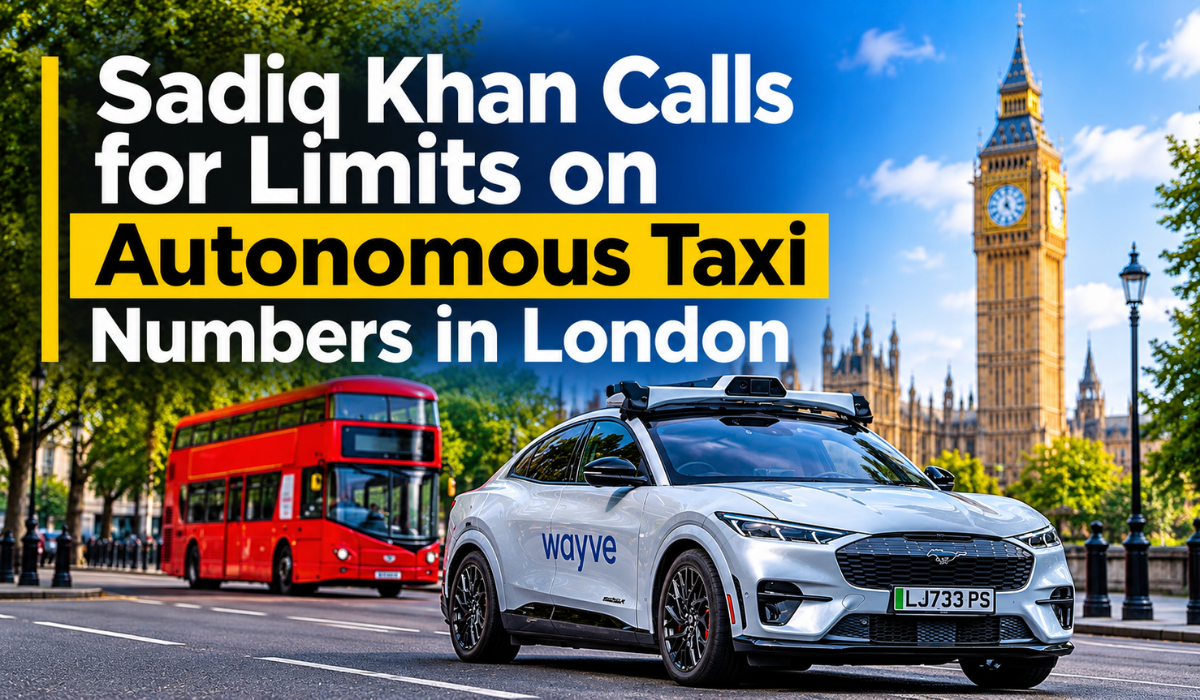
London Mayor Sadiq Khan has called on the UK government to give the capital greater control over the number of robotaxis operating on its streets. As companies prepare to expand autonomous taxi services, Khan has questioned whether existing regulations are suitable for the pace of technological development and the challenges facing London’s transport network.
His concerns include road congestion, air quality, road safety and the potential impact on private hire and black-cab drivers. He has also argued that London needs stronger regulatory powers before fully driverless taxi services become widely available.
Sadiq Khan Wants Greater Powers for Transport for London
Khan said politicians had not fully grasped the pace of change in autonomous vehicle technology. He warned against a large-scale introduction of driverless vehicles without appropriate regulation and questioned whether current rules were fit for purpose.
He wants Transport for London (TfL) to have greater authority over autonomous vehicles, including the ability to control robotaxi numbers. Khan highlighted London’s differences from cities such as San Francisco, describing the capital as a city of almost 10 million people, made up of around 400 villages with narrow roads.
Under the current arrangements described in the report, TfL can give or refuse consent for fully autonomous vehicles to operate in London, but cannot directly license or manage robotaxi services.
Khan also raised questions about how driverless taxis could affect congestion, air quality and people who depend on driving for their livelihoods. However, a formal London robotaxi cap has not yet been introduced. The Mayor is seeking greater powers to regulate the sector.
Uber, Wayve and Freenow Prepare for Driverless Services
Several companies are moving towards autonomous taxi operations in London.
Uber began offering limited passenger journeys using Wayve’s self-driving vehicles in September 2026. These services operate under a TfL licence, with a human safety driver in the front seat who can intervene when necessary.
Freenow by Lyft is also working towards introducing fully driverless Baidu Apollo Go vehicles. The company hopes to launch these services as early as 2027 under the UK’s national licensing framework.
Waymo is another company focusing on the London market. It already operates robotaxi services in several US cities and is exploring opportunities to expand into the UK.
The different stages of development highlight why the distinction between supervised autonomous trials and fully driverless commercial services remains important.
Baidu Tests Around 24 Robotaxis in Brent
Baidu’s Apollo Go vehicles are undergoing testing in London, with around 24 vehicles reportedly operating in the borough of Brent.
The vehicles feature passenger touchscreen displays and massage seats. Although Baidu already provides fully autonomous services in cities across China and the UAE, its London testing programme still involves human intervention.
During a test journey reported by The Guardian in October, the vehicles appeared to handle London’s roads safely. However, human intervention was still required during some journeys, particularly around roadworks.
The report also highlighted how autonomous vehicles can face difficulties in situations that require them to respond to changing road conditions. In some instances, other motorists have reportedly beeped at vehicles for following speed limits.
These tests demonstrate the practical challenges of introducing autonomous driving technology into London’s busy and complex road environment.
Freenow Plans a UK Depot as Taxi Job Concerns Continue
The potential effect on existing drivers remains an important part of the robotaxi debate. Driver unions have organised protests outside the London offices of Wayve and Waymo, reflecting concerns about employment and the future of traditional taxi services.
Danny O’Gorman, Freenow by Lyft’s general manager for the UK and Ireland, said the company was working closely with TfL and planned to establish a purpose-built autonomous vehicle depot in the UK.
He suggested that some displaced taxi drivers could find alternative employment in remote vehicle operations and servicing. However, the number of roles such a facility could create has not been established.
O’Gorman also argued that black-cab drivers face existing challenges, including an ageing workforce and the high cost of vehicles. He noted that around two-thirds of black-cab drivers are over 50 and said autonomous taxis were not expected to compete with the sector at scale in the immediate future.
Conclusion
The debate over a London robotaxi cap reflects wider questions about how autonomous taxi services should be introduced and regulated. While companies such as Uber, Wayve, Freenow by Lyft and Waymo are exploring opportunities in the capital, concerns remain over road conditions, congestion, employment and the powers available to local transport authorities.
Khan’s request for greater TfL control highlights the need to address these issues as the UK develops its framework for fully driverless passenger services. For now, the proposed cap remains a call for regulatory powers rather than an approved restriction. How the government responds will help determine the future scale and oversight of robotaxi operations in London.