

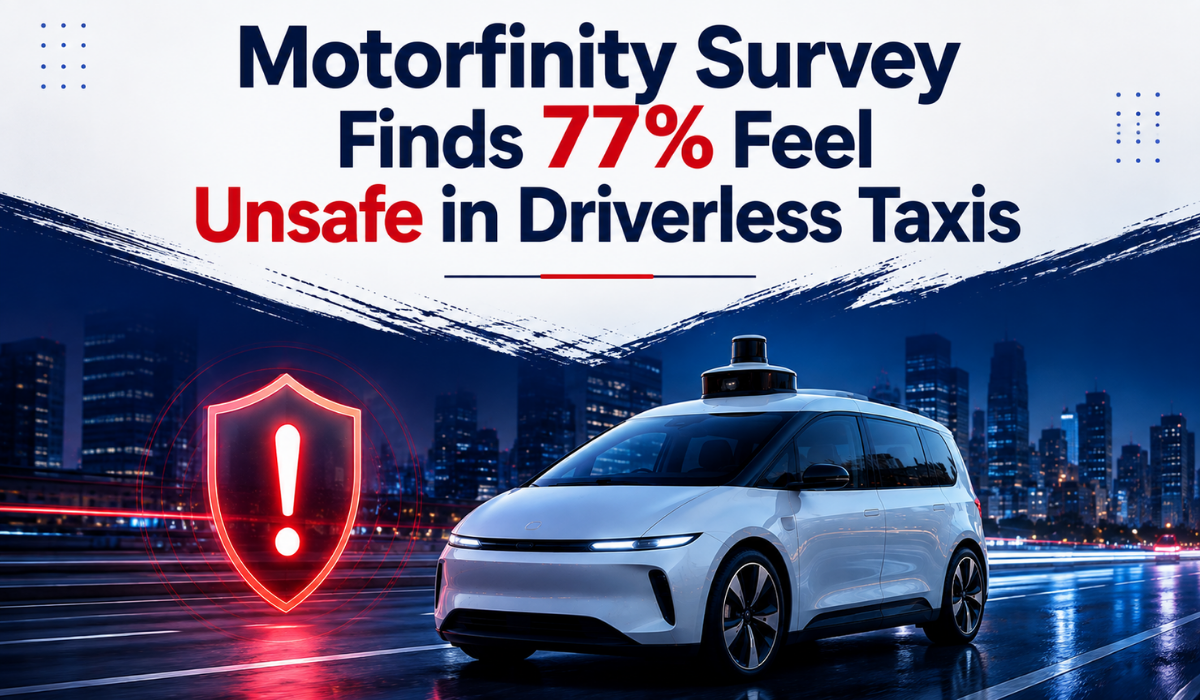
The emerging robotaxi UK market could have a significant public-confidence hurdle to overcome, according to a new Motorfinity survey.
Motorfinity conducted a snapshot survey among its customer base of frontline-worker motorists to examine attitudes towards driverless vehicle technology. The research found that 77% of respondents said they would feel unsafe travelling in a taxi without a human driver.
The findings highlight concerns about how autonomous vehicles will operate in everyday UK conditions, particularly when they encounter situations that are difficult to predict.
The survey should, however, be viewed in context. It represents the views of Motorfinity’s surveyed customer base and is not a nationally representative survey of the entire UK population.
Motorfinity Survey Findings
| Finding | Respondents |
| Would feel unsafe in a driverless taxi | 77% |
| Rated safety 0 or 1 out of 5 | 43% |
| Rated safety 4 or above out of 5 | 12% |
| Would be significantly put off using a driverless taxi | 47% |
The results show a considerable difference between respondents who expressed strong safety concerns and the smaller group that felt confident about travelling in a self-driving vehicle.
Safety Remains the Biggest Concern
Safety was one of the strongest themes in the Motorfinity research.
43% of respondents rated the safety of a self-driving car at either 0 or 1 out of 5, where zero represented unsafe and five represented completely safe.
By comparison, just 12% gave a rating of 4 or higher.
These figures describe how respondents perceive autonomous vehicles rather than proving that driverless technology is unsafe. For the robotaxi UK sector, however, such perceptions could be important because passengers need to feel comfortable before they are likely to use the services regularly.
Nearly Half Could Be Deterred From Using Driverless Taxis
The survey also examined the potential effect of driverless technology on taxi usage.
Motorfinity reported that 47% of respondents would be significantly put off using taxi services if they were driverless.
For future operators, this suggests that earning passenger trust could be as important as developing the technology itself.
Clear explanations of vehicle capabilities, safety procedures and passenger support could help address concerns among people who remain uncertain about travelling without a human driver.
Road Closures and Police Scenes Raise Questions
Respondents highlighted several situations in which they were unsure how autonomous vehicles would respond.
These included temporary road closures, restricted areas and police incidents.
One respondent specifically raised concerns about whether driverless vehicles could recognise temporary road closures, including police scenes, and respond safely.
Other participants questioned what passengers would do if a driverless vehicle were involved in an accident. Some also wanted greater assurance about how manufacturers could demonstrate the safety of the technology.
These comments point to a broader question for the robotaxi UK industry: how effectively can autonomous systems deal with circumstances that change after a vehicle has begun its journey?
Potential Impact on Professional Drivers
The survey also identified concerns beyond passenger safety.
Some respondents were worried about the potential effect of autonomous taxis on employment, particularly for black cab and Uber drivers.
The increasing use of driverless vehicles could alter the taxi industry if autonomous services eventually become widespread. However, Motorfinity’s research does not estimate the number of jobs that could be affected.
The employment concerns should therefore be treated as respondents’ perceptions rather than a forecast of future job losses.
Motorfinity Calls Safety a Priority
Motorfinity CEO Dan Briggs said the survey offered an interesting snapshot of public reaction to robotaxis entering the UK.
Briggs described driverless taxis as an exciting development and a significant milestone for vehicle technology. He also noted that similar autonomous services have already been operating in locations including San Francisco, Phoenix and China.
At the same time, he acknowledged that the technology will represent a major adjustment for the public.
Briggs particularly highlighted the complexity of European road systems and said safety needs to remain a priority. He added that the survey showed people want to understand more about how autonomous vehicles will deal with UK roads, temporary closures and potential accidents.
What Could Improve Robotaxi UK Acceptance?
Building confidence could require technology companies and operators to provide clear answers to practical passenger questions.
Areas that may need greater explanation include:
- How autonomous vehicles detect temporary road closures
- How they respond to police or emergency scenes
- What happens when an unexpected obstacle appears
- How passengers can obtain assistance
- What procedures apply after an accident
- How responsibility and liability are handled
Addressing these questions could help people understand what to expect when using a driverless taxi.
FAQ About Robotaxi UK
What did the Motorfinity survey find?
Motorfinity reported that 77% of respondents said they would feel unsafe travelling in a taxi without a human driver.
Does the 77% figure represent all UK residents?
No. The survey was conducted among Motorfinity’s customer base of frontline-worker motorists. It should not be presented as representative of the entire UK population.
What percentage rated driverless safety very low?
43% gave a rating of 0 or 1 out of 5.
How many respondents expressed higher confidence?
12% rated safety at 4 or above out of 5.
Would a driverless taxi affect people’s willingness to use taxis?
According to Motorfinity, 47% said they would be significantly put off using taxi services if they were driverless.
What were the main concerns?
Respondents raised issues involving road closures, police scenes, accidents, passenger safety, liability and the potential impact on professional driving jobs.
Does the survey show that UK consumers reject robotaxis?
No. It shows the views of Motorfinity’s surveyed customer base. It does not establish nationwide UK public opinion.
Conclusion
The Motorfinity research highlights several challenges facing the developing robotaxi UK market. While autonomous taxis could represent an important advancement in vehicle technology, the survey indicates that many of the motorists questioned remain uncomfortable with the idea of travelling without a human driver.
Safety was the dominant concern, alongside questions about road closures, emergency situations, accidents and the potential effect on professional drivers.
Motorfinity’s findings should not be treated as a nationwide measure of public opinion, but they do provide an indication of the concerns held by the surveyed motorists.
As the robotaxi UK sector develops, demonstrating how autonomous vehicles operate safely in complex road environments and clearly communicating those capabilities to passengers could play an important role in building public confidence.