

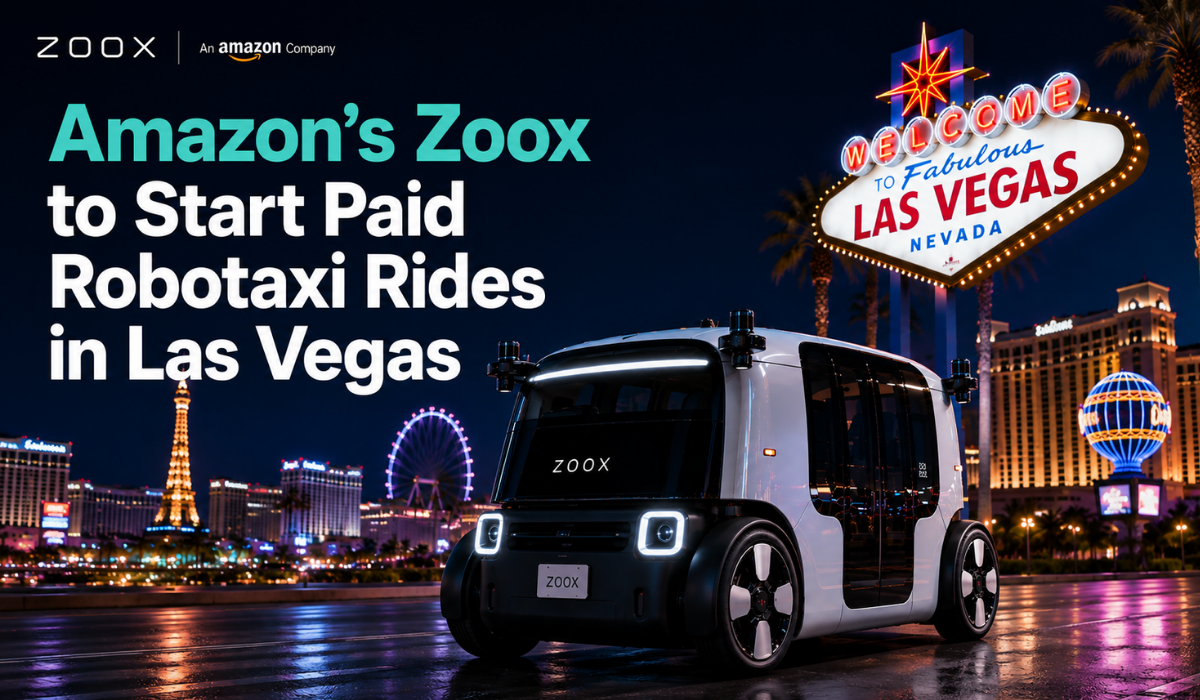
Amazon-owned Zoox robotaxi is set to begin offering paid driverless rides in Las Vegas starting next week, marking a major milestone in the company’s transition from public testing to commercial autonomous ride-hailing. The launch comes just days after the U.S. National Highway Traffic Safety Administration (NHTSA) granted Zoox an exemption from certain federal vehicle safety standards that normally require traditional human driving controls.
The commercial rollout strengthens Zoox’s position in the rapidly evolving U.S. robotaxi market, where Alphabet’s Waymo already operates paid driverless services across multiple cities and Tesla has recently begun introducing its own robotaxi service.
Zoox Begins Paid Commercial Operations
Beginning Monday, passengers in Las Vegas will be able to book and pay for rides through the Zoox robotaxi service.
Before this commercial launch, Zoox had been carrying passengers free of charge as part of its testing program in Las Vegas, San Francisco, Austin, and Miami. These pilot operations allowed the company to evaluate vehicle performance, passenger experience, and operational readiness before introducing paid services.
At present, Las Vegas is the only city where Zoox has announced commercial paid rides. The company has not disclosed when similar services will begin in its other testing locations.
Pricing Similar to Premium Ride-Hailing Services
Zoox said fares will follow a pricing structure comparable to the Comfort tier commonly offered by ride-hailing companies.
Typically, Comfort rides feature newer and more spacious vehicles and cost approximately 20% to 40% more than standard ride-hailing services.
The Zoox robotaxi pricing model will include:
- A base fare
- Time travelled
- Distance travelled
Destination-specific charges, such as airport fees, will be displayed before a trip begins. The company also confirmed that passengers will not pay additional charges if the robotaxi takes a longer route than originally planned, providing greater pricing transparency for riders.
A Purpose-Built Driverless Vehicle
Unlike many autonomous vehicle developers that modify conventional passenger vehicles, the Zoox robotaxi was designed from the ground up specifically for autonomous transportation.
Its distinctive electric vehicle features two rows of inward-facing seats, creating a carriage-style cabin designed for shared mobility rather than traditional driving.
The vehicle operates without conventional human driving controls such as a steering wheel or pedals, reflecting Zoox’s vision for future driverless transportation.
Federal Exemption Marks a Significant Milestone
The commercial launch follows Zoox becoming the first autonomous ride-hailing company to receive an exemption from federal vehicle safety standards requiring traditional human controls for a purpose-built robotaxi.
The NHTSA determined that Zoox’s vehicle provides a level of safety comparable to vehicles that meet existing federal motor vehicle safety standards.
However, the approval is limited in scope. The exemption allows Zoox to deploy up to 2,500 driverless vehicles during each of the next two years, rather than providing unlimited commercial deployment.
In addition, NHTSA has imposed extra reporting requirements covering incidents such as crashes and situations where robotaxis stop unexpectedly on public roads, ensuring continued regulatory oversight as commercial operations expand.
Competition in the U.S. Robotaxi Market
The Zoox robotaxi launch further intensifies competition in the U.S. autonomous ride-hailing industry.
Waymo already operates commercial driverless services in multiple cities and continues expanding its network, while Tesla has recently started rolling out its own robotaxi service.
With commercial rides now beginning in Las Vegas, Zoox joins a small group of companies actively offering paid autonomous transportation while continuing to refine and expand their driverless technology.
Ongoing Safety Oversight
Although commercial deployment marks an important achievement, the Zoox robotaxi program continues to operate under close regulatory oversight.
Autonomous vehicle companies face ongoing scrutiny regarding how their systems respond to emergency vehicles, temporary road closures, pedestrians, cyclists, and other complex driving situations.
Zoox has also issued several software recalls over the past two years. Most recently, in July 2026, the company released a software update after one of its robotaxis struggled to detect heavy smoke at an emergency scene during testing.
The incident highlights the continuous software improvements required as autonomous driving technology evolves and reinforces why regulators continue monitoring commercial deployments closely.
Zoox Robotaxi at a Glance
| Feature | Details |
| Parent Company | Amazon |
| Commercial Launch | Las Vegas |
| Previous Testing Cities | Las Vegas, San Francisco, Austin, Miami |
| Vehicle Design | Purpose-built driverless electric robotaxi |
| Seating Layout | Two inward-facing rows |
| Pricing Model | Base fare + time + distance |
| Federal Exemption | Up to 2,500 vehicles per year for two years |
| Regulatory Oversight | Additional NHTSA safety reporting requirements |
Why This Launch Matters
The Zoox robotaxi commercial launch represents more than the introduction of a new ride-hailing service. It demonstrates increasing regulatory confidence in purpose-built autonomous vehicles that operate without traditional human driving controls.
At the same time, the launch reflects the growing competition among companies investing in autonomous transportation. Waymo has already established commercial driverless services in multiple U.S. cities, while Tesla has begun rolling out its own robotaxi platform. Zoox now joins this competitive landscape with a vehicle designed specifically for autonomous mobility rather than adapting an existing passenger car.
Although the current rollout is limited to Las Vegas, the launch provides Zoox with an opportunity to gather real-world commercial operating experience while continuing to refine its technology under regulatory supervision.
Key Takeaways
- Zoox robotaxi will begin paid driverless rides in Las Vegas starting Monday.
- The commercial launch follows an NHTSA exemption allowing limited deployment of purpose-built driverless vehicles.
- Zoox previously offered free public testing rides in Las Vegas, San Francisco, Austin, and Miami.
- Pricing follows a base fare plus time and distance model, similar to the Comfort tier offered by other ride-hailing companies.
- Comfort-tier rides typically cost 20% to 40% more than standard ride-hailing services.
- Passengers will not pay extra if the robotaxi takes a longer route than originally planned.
- The federal exemption allows deployment of up to 2,500 vehicles during each of the next two years.
- Zoox remains subject to additional NHTSA reporting requirements and ongoing safety oversight.
Frequently Asked Questions
What is Zoox robotaxi?
The Zoox robotaxi is Amazon’s purpose-built driverless ride-hailing vehicle designed specifically for autonomous transportation without traditional human driving controls.
Where is Zoox launching paid rides?
Zoox will begin offering paid commercial rides in Las Vegas, following earlier free public testing in Las Vegas, San Francisco, Austin, and Miami.
How are Zoox robotaxi rides priced?
Fares are calculated using a base fare combined with travel time and distance. Destination-specific charges, such as airport fees, are shown before the trip begins.
Is Zoox approved for unlimited commercial deployment?
No. The NHTSA exemption currently allows Zoox to deploy up to 2,500 driverless vehicles in each of the next two years, along with additional safety reporting requirements.
Why is this launch important?
The launch marks Zoox’s transition from public testing to paid commercial service and makes it the first autonomous ride-hailing company to commercially deploy a purpose-built robotaxi under this type of federal exemption.
Conclusion
The launch of the Zoox robotaxi paid service in Las Vegas marks a significant step forward for Amazon’s autonomous mobility ambitions. Backed by a federal exemption for its purpose-built driverless vehicle, Zoox is moving from years of public testing toward commercial operations in one of the most competitive autonomous transportation markets.
While the rollout is currently limited in scale and remains subject to ongoing regulatory oversight, it places Zoox alongside Waymo and Tesla in the race to expand autonomous ride-hailing services across the United States. As the company gathers operational experience and continues refining its technology, the Las Vegas launch will serve as an important milestone in the broader evolution of commercial robotaxi services.